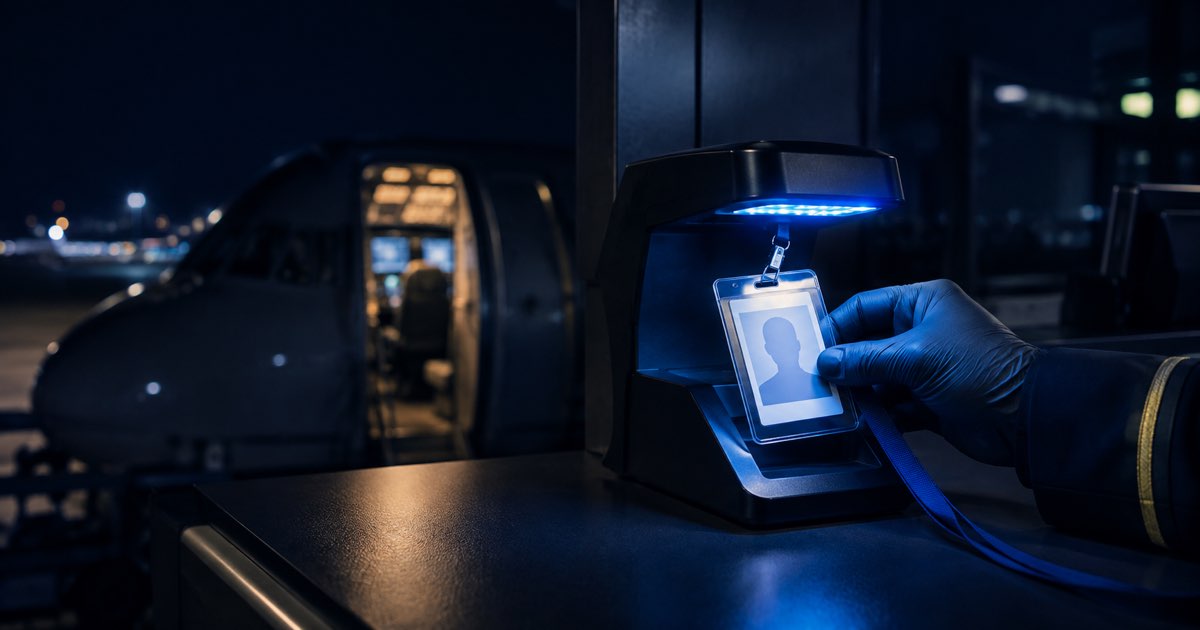
The case exposes a verification failure, not proof that an impostor entered a cockpit. The U.S. Attorney's Office says Dallas Pokornik used a fictitious employee ID to obtain hundreds of free flights on three airlines. The admitted scheme lasted more than four years, from January 2020 to October 28, 2024. An earlier charging release says he requested a cockpit jumpseat, but the public record does not say that any request was granted.

For an airline, the practical lesson is narrower than the headlines and more useful. A badge is only a claim. The access decision needs a live chain linking the person, the issuing employer, current employment and the exact travel or flight-deck privilege requested.

What the guilty plea establishes

The U.S. Attorney's Office for the District of Hawaii reported on August 7, 2026 that Pokornik had pleaded guilty the previous day to wire fraud.

According to that official release, Pokornik was a former flight attendant for a Canadian commercial airline. He admitted falsely posing as a commercial pilot, using a fictitious employee identification card and obtaining hundreds of free flights from three U.S. airlines. The admitted scheme ran from January 2020 through October 28, 2024. He also agreed to pay restitution to the three victim airlines.

The same release says he was indicted in October 2025, arrested in Panama and extradited to the United States. His sentencing hearing is scheduled for December 8, 2026, before U.S. District Judge Shanlyn A.S. Park. That hearing is still in the future as this article is published. The stated maximum penalties are not a forecast of the sentence the court will impose.

The cockpit detail comes from an earlier stage. In its January 20, 2026 charging release, the Justice Department said Pokornik requested a jumpseat in the cockpit despite not being a pilot and not holding an airman certificate. The release did not say he occupied one. That distinction must survive the headline: requested is not admitted.

Jan 2020 Oct 2024 Oct 2025 Aug 2026 Dec 2026 Scheme begins Admitted use of fictitious ID Scheme ends October 28, 2024 per DOJ Indictment October 2, per DOJ Guilty plea August 6, per DOJ Sentencing Scheduled Dec 8
The official record separates the admitted travel fraud from a cockpit request and from a future sentence.

One case, two access questions

The story contains two decisions that should not be collapsed.

The first is an employee-travel decision. A carrier gives an eligible airline worker a free or discounted seat under an interline or staff-travel arrangement. The Justice Department says the fictitious ID unlocked hundreds of those flights across three airlines. That is the conduct admitted in the guilty plea.

The second is a flight-deck admission decision. 14 CFR 121.547 limits who a certificate holder may admit to a flight deck. The rule includes authorized employees, FAA or NTSB representatives and certain other people whose duties or permission qualify them. The pilot in command's permission is one required element of admission, and the rule preserves the pilot in command's emergency authority to exclude anyone, subject to the rule and the operator's approved procedures.

The official record does not establish that the second decision was ever approved for Pokornik. It establishes that the request was made. That is still operationally important because a credible request can reach the point where gate staff and a captain must resolve identity, status and eligibility under time pressure.

The difference also prevents an easy but false conclusion. Passenger screening, staff travel and flight-deck access are not one control. Passing through an airport and receiving a cabin seat does not establish cockpit eligibility. A strong system tests each claim at the boundary where it matters.

What the FAA verification chain actually asks

The most specific public FAA document is historical Notice N 8000.356, issued in 2007 for approval of flight-deck jumpseat programs under OpSpec A048. It should be read as FAA guidance for those approved procedures, not as a claim about the undisclosed systems used by the three victim airlines.

The notice says verification at gate check-in must cover three facts: identity, employment status and jumpseat eligibility. An employer-issued photo ID is required, but it is only one item in the process. The verification result must include the requester's name, employee number and flight-deck eligibility.

For non-company flight crewmembers, the notice adds an appropriate airman certificate; it states that an airman certificate is not required for every CASS-eligible person, such as flight followers. It also requires a current medical certificate when the requester serves as a flight crewmember for the employer. The notice describes two program families:

  • CASS. The Cockpit Access Security System is a network of databases hosted by participating Part 121 carriers. The notice says it is intended to verify identity, employment and jumpseat eligibility at check-in.
  • FDAR. A Flight Deck Access Restriction program serves the same purpose outside CASS. The notice permits direct-access systems and conventional contact by telephone, email or fax, subject to approved procedures and TSA restrictions.

The common requirement is a positive confirmation, not a visual impression. The database or issuing contact has to answer a current question about this person and this privilege.

That is why the badge remains necessary but insufficient. A genuine badge can outlive employment. A copied badge can carry a real employee number. A perfect forgery can look more convincing than an old genuine card. None of those artifacts answers whether the employer recognizes the person today or whether flight-deck access is authorized for this trip.

Industry specialists made the same point from different directions after the indictment. John Cox, a retired pilot who runs an aviation safety firm, spoke to the Associated Press on January 21, 2026. His hypothesis: "The only thing I can think is that they did not show him as no longer employed by the airline." It was not a finding about any victim carrier.

Former regional pilot Dan Bubb focused on the artifact itself. He told CBC News on August 10, 2026 (updated August 11) that the case was "kind of a wake-up call to all of us that people can manufacture authentic-looking IDs." Again, that observation explains the control risk; it does not prove which internal check failed.

Five links that a badge alone cannot supply

A reliable access decision is a chain. Each link answers a different question, and a green answer at one link cannot substitute for another.

  1. Artifact integrity: is the credential unchanged from what its issuer produced?
  2. Issuer authenticity: did the named employer actually issue it through an authorized process?
  3. Holder binding: is the person presenting it the person to whom it was issued?
  4. Current status: is the employment relationship active now, rather than merely active when the card was printed?
  5. Privilege and context: is this holder eligible for this benefit or flight-deck role on this flight, under the operator's approved procedure?
One request, five independent checks 1. Artifact File or badge unchanged 2. Issuer Employer authenticated 3. Holder Presenter matches person 4. Status Employment active now 5. Access Eligible for this request All pass: authorize under approved procedure
A visual badge check answers only part of the access question. Each remaining link needs current, authenticated evidence.

The Pokornik record does not reveal where this chain broke. The guilty plea establishes the outcome, not the internal architecture of the victim airlines. A responsible post-incident review should therefore test every link without inventing the answer in advance.

What a carrier should be able to prove after each request

The aim is not to add a long manual at the gate. It is to make the existing approved decision short, explicit and reviewable.

  • Resolve the issuer from a trusted directory. Never call a telephone number printed on the badge. Route the query to an employer endpoint or contact already approved by the carrier.
  • Bind the result to the presented identity. Match the live response to the name, employee number, photograph and government identification required by the procedure.
  • Ask for a current status. The response should distinguish active, inactive, suspended and unknown. A stale roster entry should never silently become active employment.
  • Ask for the precise privilege. Cabin staff travel, commuting pilot travel and flight-deck jumpseat eligibility are different claims. The response should name the one being decided.
  • Fail closed on an unavailable answer. A database timeout is not a positive verification. The request moves to the approved manual route or is declined.
  • Record the decision without copying excess personal data. Keep the time, issuer, credential identifier, requested privilege, status result, verifier and outcome. Do not turn the receipt into a second personnel file.
  • Revoke quickly at the source. Offboarding has to reach every relying carrier's verification route. A secure scanner cannot compensate for an employer that leaves a former worker active.
  • Test the whole route. Red teams should use expired employment, a valid person with the wrong privilege, an unavailable issuer and a convincing forged artifact. Testing only obviously fake cards proves very little.

The receipt matters because it changes the investigation after an incident. Instead of asking whether a gate agent "looked at the badge," the carrier can establish which issuer response was received, at what time and for which privilege. That is operational evidence, not surveillance for its own sake.

Where verifiable credentials help, and where they stop

A verifiable credential can package the first, second and part of the fourth link. An authenticated employer signs a digital claim. A verifier confirms the issuer signature, detects any alteration and checks a current status or revocation source. The holder can present the minimum claim required rather than forwarding an entire HR record.

This does not require a public list of airline employees. The public component can be limited to the issuer's identity, verification keys and privacy-preserving status evidence. Personal data can remain in the credential held by the employee or in systems governed by the participating carriers.

AeroCert's current verification pattern contributes a narrower proof. A registered organization anchors a document fingerprint, and a verifier recomputes that fingerprint against the registry. That can establish that an unchanged credential was recorded by the identified issuer and whether the recorded item has been revoked.

It does not establish that the presenter is the subject. It does not confirm a live employment roster unless the employer operates the status workflow. It does not encode every airline's jumpseat agreement or replace CASS, FDAR, airport screening, an airman-certificate check, a medical check or the pilot in command's authority. Presenting it as a complete jumpseat solution would overstate the product and understate the regulation.

The sensible implementation is therefore an integration, not a replacement:

  1. The employer issues an authenticated employee credential with a non-sensitive identifier and bounded role claims.
  2. The carrier's approved CASS or FDAR route remains the authority for current employment and jumpseat eligibility.
  3. The gate workflow checks holder identity and any airman or medical certificate required for the request.
  4. The system returns one clear decision and preserves a minimal verification receipt.
  5. The pilot in command makes the final flight-deck admission decision within the operator's approved procedure.

A 30-day control review for airlines

The case offers a concrete review scope without waiting for the December hearing.

Week one: map the claims. List every route by which another carrier's employee can obtain staff travel, cabin jumpseat or flight-deck jumpseat access. Name the system of record and approved manual procedure for each.

Week two: test status freshness. Sample recently separated employees and role changes. Measure how long each source takes to reflect the change. Any unknown latency is a control gap to quantify, not a reason to assume instant updates.

Week three: exercise degraded mode. Disconnect the primary verification service and observe the gate process. Confirm that unavailable results move to the approved fallback rather than becoming an informal visual check.

Week four: replay and learn. Use synthetic credentials to test wrong employer, wrong employee number, inactive status and wrong privilege. Review the receipts, exception handling and escalation path with security, operations and the pilot group.

No part of that review depends on knowing which airline failed which check in this case. It tests the carrier's own evidence. That is the useful difference between learning from a public prosecution and speculating about unnamed victims.

The limits of the lesson

Four boundaries keep this analysis accurate.

  • The Justice Department identifies three victim airlines by country, not by name. Naming carriers based on headquarters reported elsewhere would be inference, not an official finding.
  • The public releases establish a jumpseat request, not cockpit occupancy. They do not establish how many requests were made or approved.
  • CASS is one verification program described in FAA guidance. The record does not say whether it was used, bypassed, unavailable or supplied bad data in any Pokornik transaction.
  • A guilty plea to wire fraud establishes the admitted scheme. Sentencing is still scheduled for December 8, 2026, and the maximum statutory penalty is not the expected outcome.

Those limits strengthen the operational conclusion. The case does not prove that a particular database failed. It proves that a fictitious employee card remained useful across three organizations for years. Each carrier can now ask whether its own access decision produces live, attributable evidence across all five links.

AeroCert's take

AeroCert's take: the Project Icarus case concerned an allegedly forged licence and the privilege to command an airliner. This case concerns an admitted fake employer identity used to claim travel benefits, plus a request for cockpit access that the public record does not say was granted. Licence, employment and access authorization are different credentials. A verifier must not flatten them into a generic green badge.

The strongest design is issuer-led and layered. Let the employer make an unchanged credential independently verifiable. Bind it to the holder at presentation. Query current employment and the precise access privilege. Preserve a narrow receipt. Keep the carrier's approved security program and the captain's authority intact.

That does not promise perfect security. It turns a card that merely looks right into a decision supported by evidence that can be checked, revoked and audited. See how AeroCert verification works, or integrate document integrity checks through the developer platform.

Sources

Primary sources:

Attributed context: